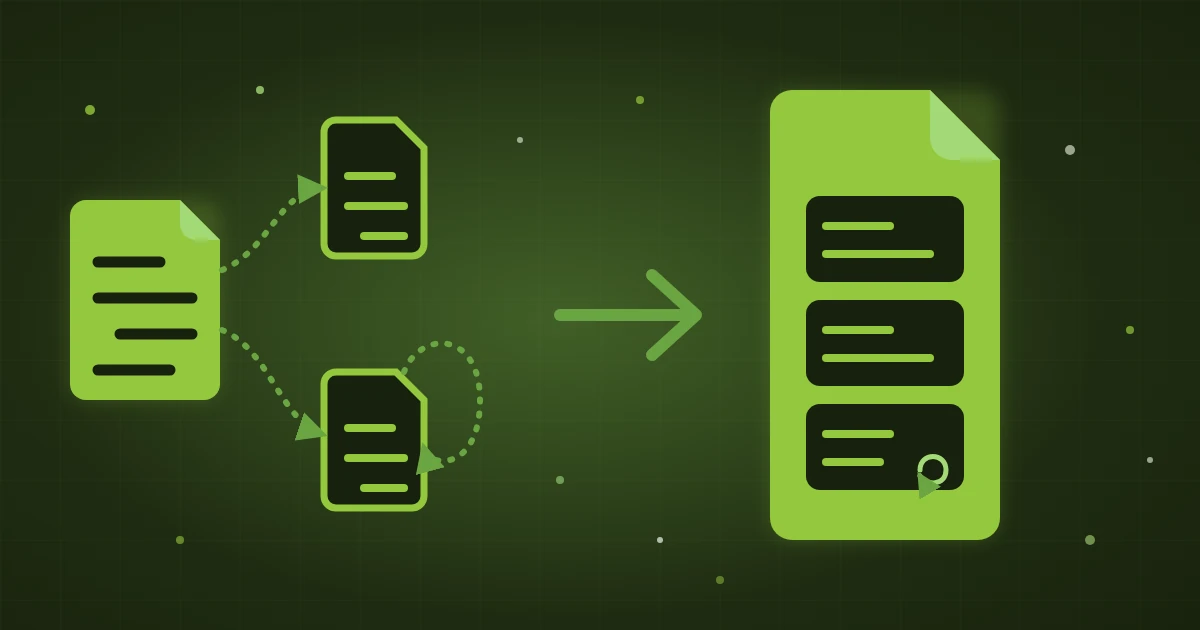
Most Arazzo documents look like one file. Open one and you see the whole workflow: the APIs it calls, the steps, the inputs, the success criteria. It is tempting to treat that file as the document, load it, and get on with whatever you are building.
Then an inputs block says $ref: ./schemas/adoption.yaml, and the file you have is no longer the document. It is the entry point to a set of files, held together by JSON Schema’s own rules about what a reference means. A tool that wants the whole thing has to go and get it. That is resolving, and this guide is about what it involves, whichever tool does it.
The guide is for anyone building on Arazzo documents: a runner that needs the complete input schema, an editor that needs to show what a reference points at, a build step that has to produce one portable file. It describes the problems and the results to expect. It does not describe a product.
What a resolved document looks like
Here is the destination first. The sample workflow is adopt-a-pet.arazzo.yaml. Its inputs live in a second file, and that file points at a third:
arazzo: 1.0.1
info:
  title: Pet adoption
  version: 1.0.0
sourceDescriptions:
  - name: petstore
    type: openapi
    url: ./petstore.openapi.yaml
workflows:
  - workflowId: adopt-a-pet
    inputs:
      $ref: ./schemas/adoption.yaml
    steps:
      - stepId: find-pet
        operationId: getPetById
        parameters:
          - reference: $components.parameters.petId
        successCriteria:
          - condition: $statusCode == 200
        outputs:
          name: $response.body#/name
      - stepId: adopt
        operationId: adoptPet
        parameters:
          - reference: $components.parameters.petId
components:
  parameters:
    petId:
      name: petId
      in: path
      value: $inputs.petId
schemas/adoption.yaml describes the inputs and points at the adopter:
type: object
required:
  - petId
properties:
  petId:
    type: string
  adopter:
    $ref: ./adopter.yaml
And schemas/adopter.yaml points at itself, because an adopter can be referred by another adopter:
type: object
properties:
  name:
    type: string
  referredBy:
    $ref: ./adopter.yaml
Three files, four references, one loop. “Resolving” this can mean three different results, and a good tool offers all three.
The reference set. The cheapest result: which files does the workflow reach through its references, and what is in each? Nothing is changed. This is the graph of files the workflow consists of.
/home/you/adoption/adopt-a-pet.arazzo.yaml
/home/you/adoption/schemas/adoption.yaml
/home/you/adoption/schemas/adopter.yaml
petstore.openapi.yaml is not in the set. A source description is not a reference. More on that below.
The bundled document. One file that still reads like the original. The workflow is untouched. The two external schemas have been copied under components.inputs, each with an $id recording where it came from, and every $ref is exactly as it was written:
workflows:
  - workflowId: adopt-a-pet
    inputs:
      $ref: ./schemas/adoption.yaml
    # steps unchanged
components:
  parameters:
    # petId, unchanged
  inputs:
    adopter:
      type: object
      properties:
        name:
          type: string
        referredBy:
          $ref: ./adopter.yaml
      $id: schemas/adopter.yaml
    adoption:
      type: object
      required:
        - petId
      properties:
        petId:
          type: string
        adopter:
          $ref: ./adopter.yaml
      $id: schemas/adoption.yaml
Copy this file to another machine and it still resolves. The $refs no longer point at the file system; they point at the $ids. The loop is still there, written down as a $ref, which a file can hold and a program can follow.
The dereferenced document. Every reference replaced by what it points at, including the Reusable Object references, which are now the parameter itself:
workflows:
  - workflowId: adopt-a-pet
    inputs:
      type: object
      required:
        - petId
      properties:
        petId:
          type: string
        adopter:
          type: object
          properties:
            name:
              type: string
            referredBy:
              # the adopter schema again: a loop the tool has to do something about
    steps:
      - stepId: find-pet
        operationId: getPetById
        parameters:
          - name: petId
            in: path
            value: $inputs.petId
        # ...
      - stepId: adopt
        operationId: adoptPet
        parameters:
          - name: petId
            in: path
            value: $inputs.petId
This is the document a runner wants: no pointers to chase while executing. It is also the one that this sample cannot simply write to a file, because of that loop. A dereferenced document with no cycles can be saved, but at a cost: it is larger, by one copy of each target per reference site, and it has lost some meaning. petId now appears three times, and nothing in the file says it was defined once. The reader cannot tell a shared parameter from three that happen to match.
For the schemas the loss goes deeper than readability: JSON Schema cannot be fully dereferenced without giving up some of its semantics. A $ref may sit beside other keywords, and both apply, so replacing the $ref with its target either drops the siblings or has to fold both into an allOf, which is a different schema. A target with its own $id establishes a base URI that its inlined copy no longer has. And $dynamicRef is resolved against the dynamic scope of an evaluation, which a document at rest does not have. A dereferenced schema is a convenience for tools that only read structure, not a replacement for the original.
Why an Arazzo document is not one file
Two features of the specification put references into an Arazzo document, and they work in opposite ways.
JSON Schema, wherever there is a schema. A workflow’s inputs is a JSON Schema. So is every schema under components.inputs. JSON Schema has $ref, and $ref can point anywhere: another part of the same file, another file, a URL. The moment someone factors a shared input schema out into a schemas/ directory, the Arazzo document depends on a file it does not contain. This is the same mechanism that makes an OpenAPI description spread across files, and it brings the same rules with it, including the one about $id that takes up most of this guide.
Reusable Objects, which never leave the file. Steps do not use $ref. A step that wants a shared parameter, success criterion, or action uses a Reusable Object, whose reference field holds an expression such as $components.parameters.petId. That expression is a lookup into the same document’s components. It cannot point outside it. So a Reusable Object never makes the document depend on another file, but a tool still has to resolve it: the step wants the parameter, not the pointer.
And then there is a third thing that looks like a reference and is not. sourceDescriptions names the API descriptions the workflow calls, each a separate document with references of its own. They are dependencies of the workflow, not parts of the document. Bundling does not copy them in, and dereferencing the Arazzo document does not require reading them. A tool may offer to follow them too, and then each one is resolved as its own document, on its own terms. The Parsing Arazzo Documents guide covers that network.
So a self-contained Arazzo document is one whose every $ref points inside it. Many are, and a schema shared between workflows in the same document can live under components.inputs without breaking that. A schema shared between documents cannot: it lives in a file of its own, and every document that uses it stops being self-contained.
Three jobs behind one word
Ask three tool builders to “resolve the references” and you get three different programs. “Resolving” is the ambiguous word here: people use it for any of them, and for all of them together. The precise terms are worth learning, because tools, specifications, and bug reports mean different things by the loose one.
| Job | What happens to a reference | What you get | Use it for |
|---|---|---|---|
| Resolve | Left alone. The document it names is fetched and parsed, and so is every document that one names. | The reference set: the graph of documents the workflow consists of, each with its absolute URI | Dependency lists, reviews, “what will this touch?” |
| Bundle | Kept as written. Its external target is copied into the entry document. | One compound (self-contained) file that reads like the original | Publishing, sharing, anything that moves the file |
| Dereference, also called inlining or inline bundling | Replaced by its target. | One document with no references left | Executing, evaluating, anything that reads the content |
Underneath all three sits one mechanical step, URI resolution: turning a reference as written (./adopter.yaml) into an absolute canonical URI against the right base, so it can be fetched. It is a step, not a job, and most of the difficulty in the next section is about getting it right.
Resolving is the prerequisite of the other two: nothing can be copied or inlined until it has been fetched. The other two are alternatives, and choosing between them is the first decision a tool makes. Bundle when the output is a file. Dereference when the output is a data structure in memory. Doing the wrong one shows up later as a bundle nobody can read or a dereferenced tree nobody can save.
This guide uses the three precise words from here on, and “resolving” in the loose sense only in its title.
Why resolving Arazzo is hard
Each of the three jobs looks like a loop over references with a file read inside it. Here is where that loop goes wrong.
Relative to what?
./adopter.yaml means nothing on its own. It is relative to a base URI, and the first question is which one. The obvious answer, the location the document was read from, is right only when the document was read from somewhere. A document handed over as a string, from an editor buffer or an HTTP body, has no location. A tool that resolves references from in-memory content needs to be told a base, or every relative reference in it is unresolvable. Arazzo 1.1.0 adds $self, which lets a document state its own URI, and an implementation has to honour that over the retrieval location when both are present.
Identity is not location
This is the one that takes longest to get right, and it sits under bundling and dereferencing alike.
Under the JSON Schema 2020-12 rules that Arazzo and OpenAPI 3.1 use, a schema can declare its own identity with $id. That identity is a URI, and it is what references are matched against. Where the schema was read from is a separate fact, and it is the less important of the two. Three consequences follow, and a second sample, adopt-a-pet.identities.arazzo.yaml, shows all three. It is the same workflow with its schemas embedded, each carrying an $id:
workflows:
  - workflowId: adopt-a-pet
    inputs:
      $ref: https://example.com/schemas/adoption.yaml
    # steps as before
components:
  inputs:
    adoption:
      $id: https://example.com/schemas/adoption.yaml
      type: object
      properties:
        petId:
          type: string
        adopter:
          $ref: adopter.yaml
      $defs:
        adopter:
          $id: adopter.yaml
          type: object
          properties:
            name:
              type: string
A reference is matched by identity before anything is fetched. inputs points at https://example.com/schemas/adoption.yaml. There is no such server. Dereferencing succeeds anyway, without a network request, because a schema in the document declares that URI as its $id. The reference set of this document is one file. A tool that treats a $ref as an instruction to fetch has this backwards: the first question is whether something already read answers to that name.
A relative $id resolves against the enclosing $id. The nested schema says $id: adopter.yaml. That is not a file. It is relative to the base URI in force where it appears, which is its parent’s https://example.com/schemas/adoption.yaml, so the nested schema’s identity is https://example.com/schemas/adopter.yaml. Identities nest the way directories do, except that nothing on disk has to match.
A relative $ref resolves against the enclosing $id too. $ref: adopter.yaml sits inside the schema whose $id is https://example.com/schemas/adoption.yaml, so it means https://example.com/schemas/adopter.yaml, and that is exactly the identity the nested schema just declared. The two meet, and the $ref is satisfied from inside the document. Dereferenced, adopter is inlined and the result is the same schema a file on that server would have given.
Now put the rule the other way round. Take the first sample, whose schemas/adoption.yaml is a real file on disk, and give it one line at the top:
$id: https://example.com/schemas/adoption.yaml
type: object
# ...
properties:
  adopter:
    $ref: ./adopter.yaml
The file is still read from schemas/adoption.yaml. But ./adopter.yaml inside it now means https://example.com/schemas/adopter.yaml, nothing in the document answers to that name, and a dereferencer that goes looking for it on the local disk is wrong. A correct one fails with a message like:
Cannot resolve $ref "./adopter.yaml": Error while reading file "https://example.com/schemas/adopter.yaml"
That failure is the right answer. The schema said where it lives.
The consequence for a tool: it cannot resolve references with a base URI it worked out once, at the top, and it cannot go to the file system first. It needs an index of every $id in every document it has read, each made absolute against its parent, and every lookup goes through that index before any fetch. And because bundling changes the document while walking it, the index has to reflect the document as it is now, not as it was when parsing finished. An index taken as a snapshot is wrong the moment the first schema is copied.
Bundling is relocating
Copying a schema into components.inputs moves it. Every relative $ref inside it meant something at the old location. At the new one, without help, it means something else or nothing. So a bundler is not copying content, it is relocating it, and it has to leave the content able to find its targets from where it now sits.
The JSON Schema answer is to give the copy an $id recording its origin, relative to the entry document (schemas/adopter.yaml above), so its $refs keep resolving against that. Two ways to get this wrong are common. Assign the copy’s absolute retrieval path as its $id, and the bundle carries a path from your machine and works only there. Skip the $id and rewrite each $ref to #/components/inputs/adopter instead, and it works until a schema declares its own $id, at which point the rewritten reference and the schema disagree about what the schema is called.
The test is simple. A bundle is only a bundle if you can move it. If the output still needs the directory it was made in, or the network, it is not self-contained, whatever it looks like.
One target, many sites
$components.parameters.petId is referenced from both steps. In the dereferenced document, each step has its own copy of the parameter, or does it? If the copies are separate, the dereferenced document is larger than the original by the number of reference sites, and a large shared schema referenced from twenty places is inlined twenty times. If they are shared, changing one changes them all, which surprises anyone who thought they were editing a tree.
Neither answer is wrong, but a tool has to pick one and say so, because the caller’s code depends on it. Copies give a tree that can be mutated freely and grows with every reference site. Sharing gives a graph, not a tree, even when nothing loops: smaller, but a change in one place shows up in every other, and anything that mutates it has to clone first.
The loop
adopter.yaml refers to itself. Dereferencing replaces referredBy with the adopter schema, whose referredBy is the adopter schema, and so on. The first thing a dereferencer needs is to notice the reference that closes the loop. The second is a policy for it, and there are three defensible ones:
- Leave it. The in-memory graph loops. Fine for a program that walks it with a visited set. Fatal for
JSON.stringify, and quietly wrong for a YAML serializer that writesnullwhere the loop closes. - Replace it. The closing reference becomes a marker, typically the target’s URI, and the graph is acyclic again. The output can be saved. Whoever reads it needs to know what the marker means.
- Refuse. Some tools are entitled to say that cycles are not allowed in their input.
Bundling has none of this trouble. A $ref can point at its own container, so the loop is simply written down. When the goal is a file, that is a strong reason to bundle rather than dereference.
Two document families, three reference systems
An Arazzo document has JSON Schema references and Reusable Object references. The OpenAPI descriptions it names have Reference Objects, and in OpenAPI 2.0 and 3.0 those are not JSON Schema references: a Reference Object is a plain pointer to a location, with no $id and no relocation rules, while in OpenAPI 3.1 a schema $ref is full JSON Schema again. A tool that resolves an Arazzo document and offers to follow its source descriptions is resolving under three sets of rules, and bundling under two: a hoisted 3.0 schema gets its $ref rewritten to point into components, a hoisted 3.1 schema keeps its $ref and gains an $id.
What to do when a reference is dangling
$ref: ./schemas/nope.yaml. The file is not there. For a build step, stopping at the first unresolvable reference is right: nothing downstream should run on a document with a hole in it. For an editor or a linter it is exactly wrong: the tool should process everything that resolves and report everything that does not, with the reference and where it sits. A dereferencer or bundler needs both modes, and the second one has to leave the dangling reference in place, as written, so the report can point at it. The same goes for a Reusable Object whose $components target does not exist: same hole, same two modes.
Doing it by hand
How far does a loader plus a file read get? Worth seeing, because that is where first attempts start:
import { readFile } from 'node:fs/promises';
import path from 'node:path';
import YAML from 'yaml';

async function load(file) {
  return YAML.parse(await readFile(file, 'utf8'));
}

async function dereference(node, dir) {
  if (Array.isArray(node)) return Promise.all(node.map((item) => dereference(item, dir)));
  if (node === null || typeof node !== 'object') return node;
  if (typeof node.$ref === 'string') {
    const target = path.resolve(dir, node.$ref);
    return dereference(await load(target), path.dirname(target));
  }
  const out = {};
  for (const [key, value] of Object.entries(node)) out[key] = await dereference(value, dir);
  return out;
}

const doc = await dereference(await load('./adopt-a-pet.arazzo.yaml'), '.');
Twenty lines, and it works on the sample right up to adopter.yaml, which it reads, and reads again, and never returns from. Fix that with a visited set and you have a working first version. The trouble is everything the first version does not know:
- It resolves against the directory, always. Add an
$idto a schema and it reads the wrong file, silently, because a file with that name may well exist. - It only knows
$ref.reference: $components.parameters.petIdis a string to it. Steps stay unresolved. - It only knows files. A
$refto a URL, afile://URL, or a JSON Pointer fragment (#/definitions/adopter) is a read error or a wrong path. - It copies. Every reference site gets its own inlined copy, so a shared schema is read and inlined once per site. On a document with real reuse, the output is many times the input.
- It has one policy for a cycle (whatever the visited set does), one policy for a missing file (throw), and no way to bundle at all, because bundling needs the
$idbookkeeping it skipped. - It has no positions. When it fails, it cannot say which line the reference was on.
Each of these is a solved problem somewhere: the resolution rules are in RFC 3986, the $id and bundling rules in JSON Schema, pointers in RFC 6901. The cost is in assembling them, and in fixtures. A test suite whose files all sit in one directory tests nothing about location, and location is the whole problem. A saved expected output proves only that the output has not changed, never that it was right.
What a good implementation gives you
Turn the problems around and you get a checklist, for an implementation you pick or one you build. It describes results, not an API.
- All three jobs, separately, under their own names. Resolve returns the reference set, each document with its absolute URI. Bundle returns one file. Dereference returns one structure. The caller chooses; the tool does not guess.
- A base URI for everything. Documents read from a location carry it. In-memory documents can be given one.
$selfis honoured. Nothing relative is resolved against “the current directory” by accident. - An
$idindex that is live. Every lookup goes through the identities declared in the documents read so far, each made absolute against its parent, as they are now, before any file or network read. A schema that says where it lives is believed. - A bundle you can move. Hoisted schemas get an
$idrelative to the entry document, never an absolute path from the machine that made it.$refs are left as written where JSON Schema 2020-12 rules apply and rewritten where Reference Object rules apply. The result resolves from any directory, offline. - Sharing you can predict. The dereferenced result’s sharing rule is stated: what is copied, what is shared, and what to clone before mutating.
- A named policy for cycles. Leave, replace, or refuse, chosen by the caller, with a serializer that does not silently write holes.
- Two modes for dangling references. Stop at the first, or continue and report each one with the reference text and its position, leaving it in place.
- Reusable Objects resolved too.
$componentsreferences are pointers in every sense that matters to a step, and they are resolved, reported, and skipped under the same rules as$ref. - Source descriptions as an option, not a side effect. Following them is a separate choice, with its own depth limit, and each is resolved under the rules of its own document kind.
- Errors that say which reference. The message names the reference as written and the document it sits in, and the underlying cause (file not found, wrong document kind, cycle refused) is attached, not flattened into a string.
Where resolving should stop
Knowing where these jobs stop is as useful as knowing what they do. Three things look like resolving and are not:
- Validation. A reference that points nowhere is a resolution error. Whether the schema it points at is a valid JSON Schema, whether
getPetByIdexists in the API the source description names, whether the workflow makes sense: those are validation, judged by rules that change with every release of the specification. - Evaluation.
$inputs.petIdis not a reference. It is a runtime expression, and its value exists only during a run. Dereferencing leaves it alone; the thing that executes the workflow evaluates it. - Fetching with credentials, caching across runs, retrying. Resolving fetches what a reference names, over the file system or HTTP. Authentication, proxies, and caches are the calling tool’s concern and belong in the implementation only as pluggable pieces.
So the jobs line up: a parser reads a document, these three follow its references, a validator judges the result, and a runner evaluates it. The parser guide draws the first line. This one draws the second.
Next steps
- UseArazzo’s own answer to this checklist is
@usearazzo/resolver, for JavaScript and TypeScript: resolve, bundle, and dereference, for Arazzo and OpenAPI documents. Its API reference documents every function and option. - The layer below this one is the subject of Parsing Arazzo Documents: what it takes to read one document properly, including the network of source descriptions this guide set aside.
- The rules all three jobs implement are in three documents: RFC 3986 for reference resolution, RFC 6901 for JSON Pointer fragments, and JSON Schema’s bundling article for
$idand compound documents. - The specification’s own text on the two Arazzo-specific pieces: the Reusable Object and the Components Object.
- The Ecosystem page lists the Arazzo tools that exist today, including ones that bundle and dereference.
- Something here is wrong, or missing? Say so in Discussions.